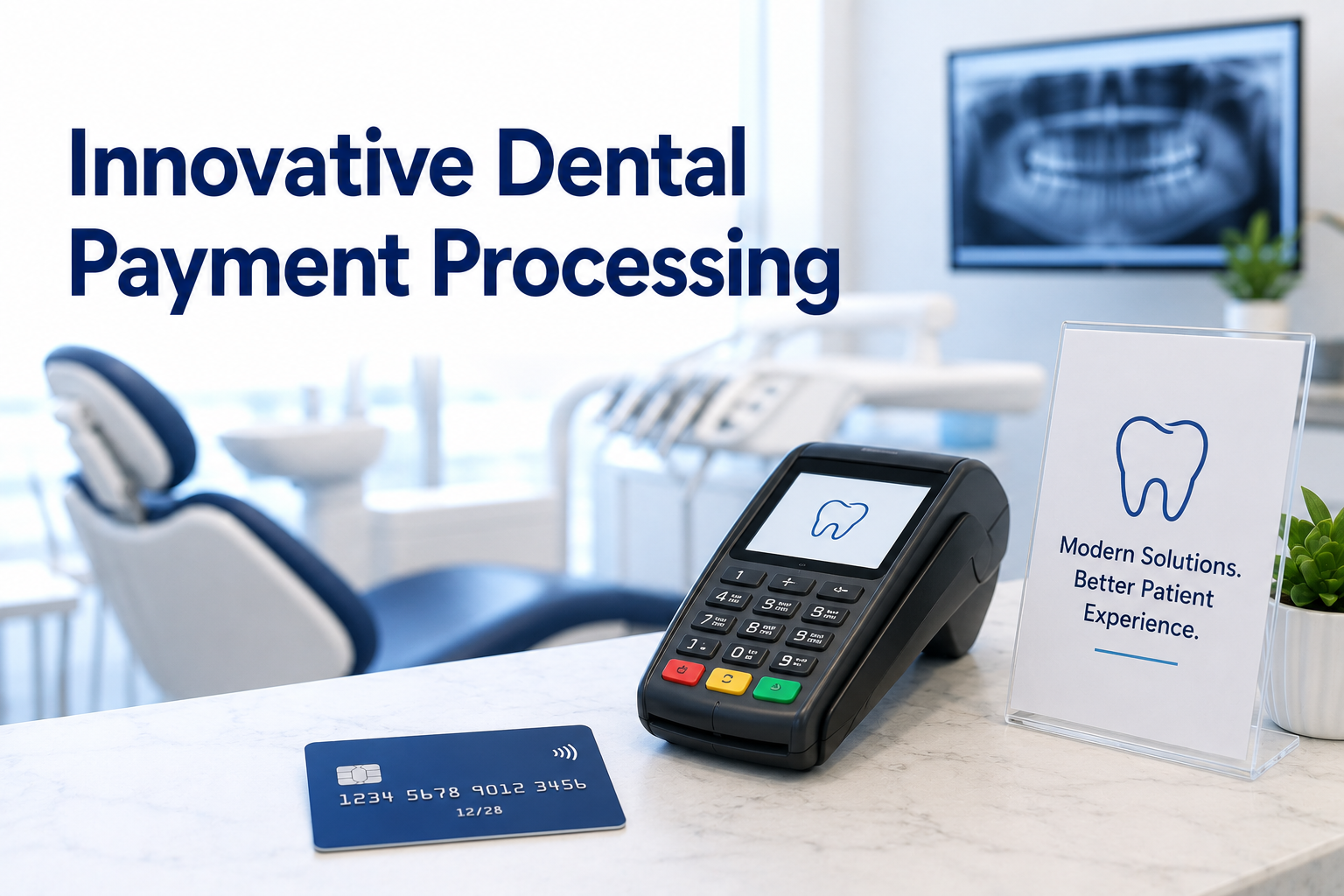
Innovative dental payment processing sounds like it should involve new hardware. In practice, the meaningful changes of the last several years have gone the other way: less equipment, less paper, and fewer separate systems doing jobs that should have been one job all along.
Most dental practices are not held back by missing technology. They are held back by a payment setup assembled years ago, one addition at a time, that nobody has looked at as a whole since. It works, so it survives, and the cost of it never appears on a single line anywhere.
This guide covers how to tell whether your setup has fallen behind, what genuinely changed, and which upgrades are worth paying for.
Signs a Dental Payment Setup Has Fallen Behind
None of these are catastrophic on their own. Together they describe a practice doing manually what its payment system should be doing.
- Card details live on paper. Authorization forms in a folder, or a number written down during a phone call to be keyed in later.
- Payments only happen at one desk. If the terminal is busy or the patient is not physically present, collection waits.
- Someone re-enters cards every month. Membership plans and payment arrangements handled by a person with a list and a reminder.
- Patients still mail checks. Post-insurance balances collected by statement and envelope, with the delay that implies.
- Card payments, ACH, and plans live in different places. Three systems, three logins, three sets of records to reconcile.
- Month-end takes an afternoon. Reconciliation as a project rather than a glance.
If several of those describe your practice, the gap is not that you lack innovation. It is that the workload has quietly migrated from the software to your staff.
What Actually Changed
Four shifts account for most of the difference between a current dental payment setup and one that has not been revisited in a decade.
From hardware to software. Taking a payment used to require a dedicated machine on a counter. A web-based virtual terminal turns any computer, tablet, or smartphone the practice already owns into a place a payment can be taken, which removes both the equipment cost and the physical constraint.
From stored paper to stored tokens. Practices used to keep card details on file literally. Tokenization replaced that with a reference the system can charge against, so repeat payments never require anyone to handle the original number again.
From one payment method to several. Cards, ACH and electronic checks, and online payments through an emailed invoice now belong in one workflow rather than three, because a patient balance can arrive by any of them.
From manual billing to scheduled billing. Membership plans and staged treatment payments run on their own once set up, instead of depending on someone remembering.
What Modern Dental Payment Systems Actually Do
Translated into daily practice, a current setup should handle all of this without a workaround:
- Take a payment from anywhere. Front desk, treatment coordinator’s office, second location, or a phone call, all through the same system and into the same records.
- Charge a stored card without re-entry. Deposit at scheduling, balance at delivery, no card details touched twice.
- Run treatment plans and memberships on schedule. Automatically, with a record of each charge.
- Send an invoice a patient can pay from a phone. The fastest route to collecting a post-insurance balance.
- Accept bank payments alongside cards. Larger balances often move by ACH, and they should not require a separate process.
- Produce receipts and one transaction history. Every payment, however taken, in one list.
- Give each staff member their own access. Individual logins with permissions scoped by role, across every location.
These are the capabilities behind BlueYonder’s dental merchant services, which is the point: they belong in one system rather than assembled from four.
What Innovation Is Not
Worth saying plainly, because the word gets used to sell things that do not help.
Innovation is not more hardware. A newer terminal on the same counter solves nothing that a web-based system had already solved by removing the counter constraint. Long equipment leases in particular tend to outlive the equipment’s usefulness, under a separate agreement with its own term.
It is not more integrations either. Practices routinely pay monthly for connections that were configured during onboarding and never used again. An integration only earns its cost if someone relies on it weekly.
And it is not a longer feature list. The measure of a payment system in a dental practice is how much work it removes from the front desk, not how many capabilities appear on the sales sheet. A system with fewer features that your team actually uses beats a comprehensive one nobody has time to learn.
The same scepticism applies to pricing dressed up as a feature. Tiered rates and bundled add-ons are presented as flexibility, when the practical effect is that you cannot tell what any individual thing costs.
Security Came Along With It
The shift away from paper and shared hardware happens to solve most of the security problems dental practices actually have. Card numbers that never get written down cannot be lost. Tokenized storage means the practice is not holding data worth stealing. Individual logins make access traceable rather than collective.
Our post on secure dental payment processing goes through those practices in more detail, but the short version is that modernizing and securing a dental payment setup are largely the same project.
Changing Without Disrupting the Practice
The usual objection is timing. No practice wants a payment system experiment during a full schedule.
Two things make it less risky than expected. A browser-based system needs no installation, so training is measured in minutes rather than days. And you do not have to cancel your existing processor to set up a new one, which means the old system stays available while your team gets comfortable. Most practices close the old account within the first month, but on their own timing rather than a single switchover day.
If you are weighing providers more broadly, our post on why dentist merchant services matter to dental practices covers the evaluation criteria.
Modern Where It Counts
Innovative dental payment processing is not a category of product. It is the difference between a practice where payments are handled by the system and one where they are handled by people working around the system. The test is simple: count how many payment tasks in your week require a human to remember, re-enter, or chase something.
BlueYonder Corp provides dental practices with a web-based virtual terminal, tokenized card storage, ACH, and online invoicing on flat monthly pricing, with no contracts, no equipment fees, and no hidden charges. See our dental payment processing page, or call 800-270-9285 to talk through your current setup.